

Phnom Penh
- mgbreslin
- Feb 23, 2024
- 3 min read
After five weeks of staying (relatively) healthy, our luck runs out in Phnom Penh, as 'digestive issues' curtail our enjoyment of Cambodia's capital city. I fall first, blaming a suspect burger in a sports bar (of all places!) before Claire succumbs to something similar on our last night in town. Whether I infected her, or whether she picked it up another way, I guess we'll never know...
For our three nights here, we are based right in the heart of the city, and have a fine view of the skyline from our balcony.

Sadly, Phnom Penh has a dark recent past, and many of the key museums and sites to visit are derived from immense human suffering. Today, it is a thriving metropolis of 2.2m residents, with a modern, vibrant atmosphere. However, less than fifty years ago, the progression of this city (with a similar population at the time) was brought to a shuddering halt, as the ruthless regime of Pol Pot and the Khmer Rouge drove people out of the city and into the countryside, with most never coming back.
As with a couple of previous posts, I am adding a reader's warning, as some of the following is quite disturbing.
Located in the centre of town is the former Tuol Svay Prey high school, which was transformed into the infamous S-21 prison by the Khmer Rouge following their rise to power in 1975. Pol Pot believed in an almost entirely agrarian state - he wanted no one to have wealth or live in cities, with everyone working on the land as a collective. Amidst the clearout of cities such as Phnom Penh, many 'enemies' of the new regime, which included anyone educated or with money, were taken here to be tortured and / or executed. The museum at S-21 contains horrific accounts of the conditions and brutality experienced here, with hundreds of photos of men, women and children who were brought here. Walking through the complex, you can see how some classrooms were subdivided to be used as cell blocks, with others used for interrogation and torture. Of an estimated 20,000 prisoners who were brought through here during the 4 year rule of the Khmer Rouge, there were only 12 known survivors.


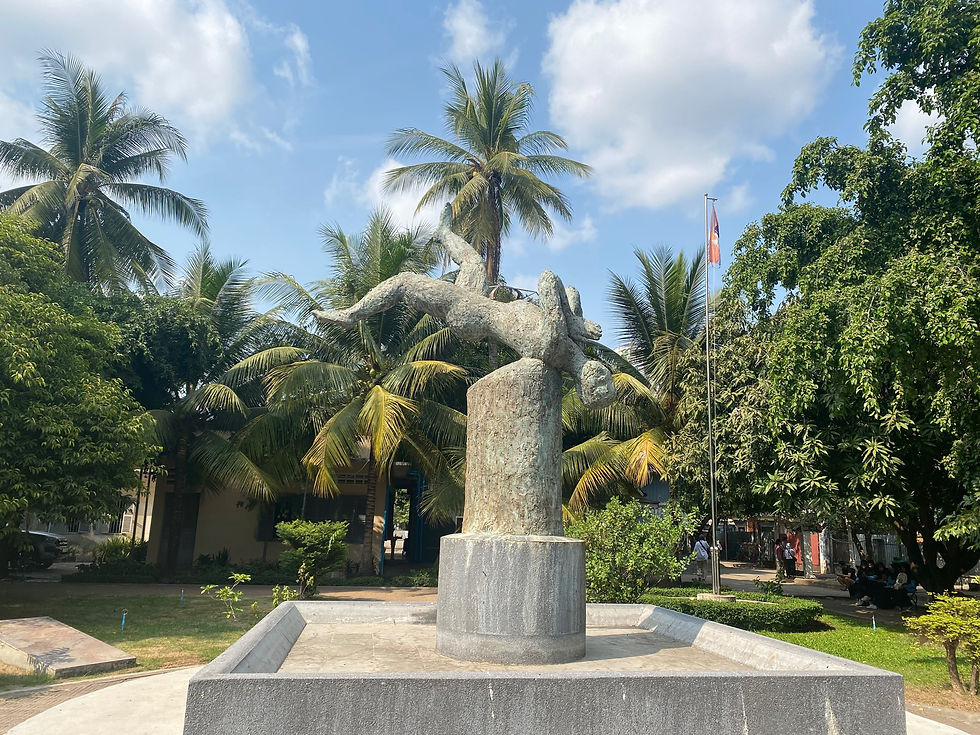
Most of S-21's victims did not die at this site however. Given the volumes of prisoners coming through, the leadership wanted a more efficient way of eliminating their enemies, and started creating large extermination centres in the countryside, which were later coined the 'Killing Fields'. We take a 30 minute trip south of the city to the Choeung Ek Genocidal Centre, a former orchard that became one such centre.
Arriving en masse from S-21 in large trucks, the prisoners were brought to an indoor holding area, before being taken outside in groups for their execution. One of the most shocking elements about the Cambodian genocide is the manner in which most victims died. Given the cost of bullets, prisoners were killed with machetes, blunt objects and even the razor sharp leaves of a specific palm tree that grew at the orchard. Most distressing of all is the so-called Killing Tree, against which numerous children and infants were killed.
Mass graves were prepared by the Khmer Rouge guards to bury the victims, and these are marked around the site, with some of the hollows still visible. Following the end of their rule, the remains of many were recovered and as a monument to the dead, a memorial stupa was built in the centre of the site, which houses more than 5,000 skulls.


Although exact figures will never be known, the genocidal reign of Pol Pot is widely reported to be responsible for the deaths of approximately 2 million people (with many also perishing from starvation and disease following the failure of the agriculture policy). This constituted a staggering 25% of the country's population at the time. Over time Cambodia has recovered, perhaps with surprising speed and completeness given the devastation of the Khmer Rouge rule, which serves as a testament to the character and resilience of its people.
Due to time constraints, a couple of temples and museums are stricken from our sightseeing list, but just before we head for our bus to leave the city, I make it to the Royal Palace over by the banks of the Mekong River. Home to the King of Cambodia, visitors can access the palace grounds, but are kept away from the King's residence and private gardens. You do however get to see the Throne Hall (still used today for religious and royal ceremonies), a couple of attractive pavilions including the Silver Pagoda, and several stupas honouring former monarchs.


It's time to head for the bus station in the north of the city for the gruelling 6 hour trip up to Siem Reap!


Comments