

Hue
- mgbreslin
- Jan 28, 2024
- 3 min read
We step off the train in Hue (pronounced Hway) before noon and as it's too early to check into the hotel, grab some lunch at a pleasant Italian / Vietnamese hybrid restaurant that we end up frequenting another few times during our stay here. For roughly 5 euro, you get bruschetta, a main course, slices of fruit for dessert, and a drink!
The rain has set in at this stage so we elect to relax in the hotel to try and get back some sleep stolen by the train journey, and plan some sightseeing for the following day.
Hue was capital of Vietnam from the early 1800s up to 1945, and much of the draw here revolves around the enclosed Imperial City area and the elaborate tombs of the emperors who served during this period. The sights are spread out around the outskirts of the city and it's another damp day, so we've arranged a local driver to takes us from place to place. The first stop is the Thien Mu Temple, which features a seven story pagoda still used by Buddhist monks. It is widely seen as an unofficial symbol of the city, and several notable religious inequality and anti-communism protests have taken place here.


On the way to our next stop, we briefly visit an 'incense village', where locals are producing a wide range of incense candles, and not so subtly suggest we should buy some. Conveniently we have not bought any souvenirs yet, so are happy to oblige!

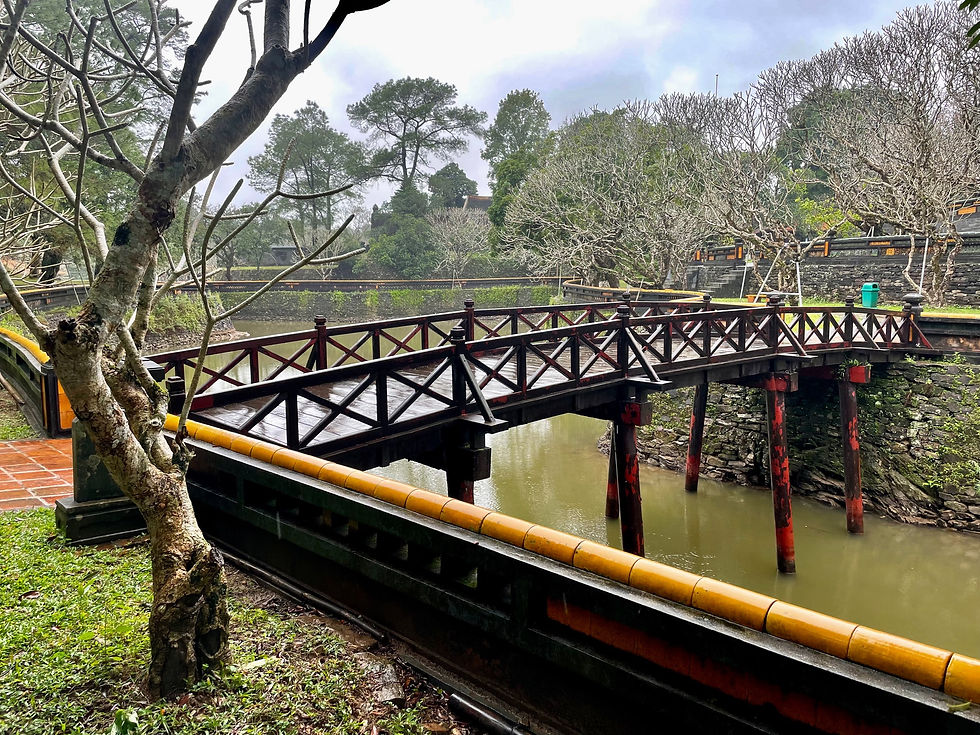
The Tomb of Emperor Tu Duc occupies 12 acres southwest of Hue. This emperor actually arranged its construction several years before his death and lived there with some of his 104 wives for many years. Apart from the tombs for himself and his (favourite) wife, these beautiful grounds also feature some small palaces, a lake and a pavilion. Parts of many of the walls have been painted yellow, which is the symbolic colour for good luck and prosperity in Vietnam.


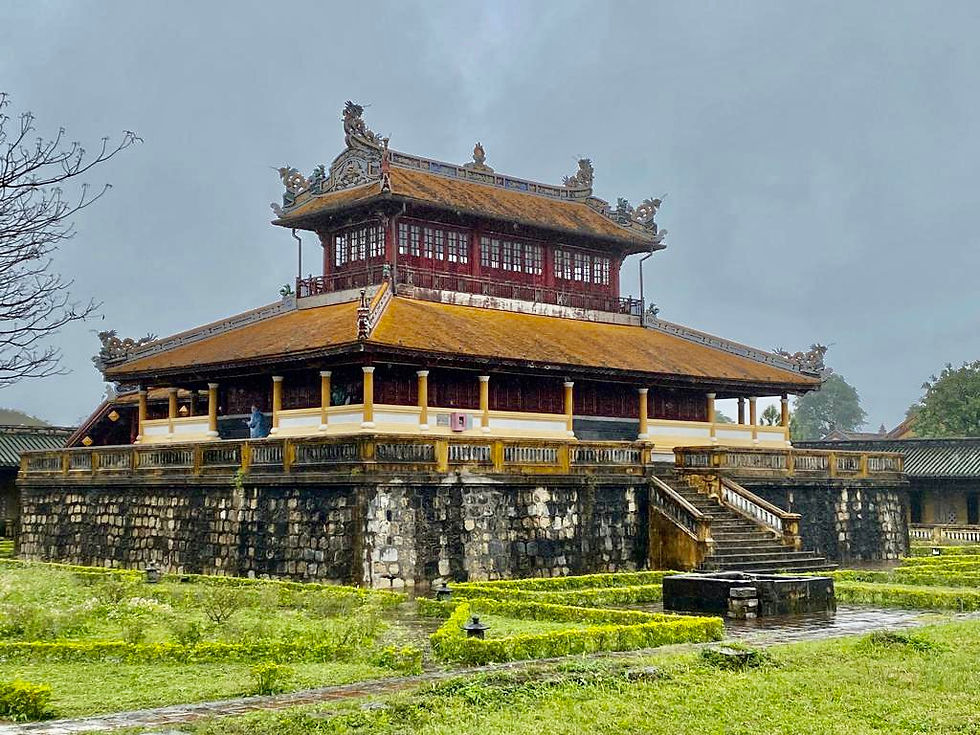
Back in central Hue, the Imperial City complex sits on the northern side of the Perfume River, protected by a moat and full perimeter wall. Built for the Nguyen dynasty in the early 19th century and modelled on Beijing's Forbidden City, this is a huge complex comprising a number of palaces, shrines and pavilions. After passing through the main gate, we make our way through the gardens, admiring the stunning architecture.




Away from the historical sites, the city centre of Hue resembles a smaller version of Hanoi, with far less chaos on the streets, which lends to a calmer, more relaxed atmosphere. There are fewer historical buildings here, as the area was a key flashpoint during the Vietnam war and much of it was destroyed during the Tet Offensive.
Our hotel is a unique building, and a very comfortable base in a great location. It's just a short stroll to the main bar / restaurant area and to the promenade on the Perfume River.


Motorbikes are king on most city centre roads in Vietnam, but we do notice more bicycles in Hue. But not ordinary bicycles, mainly those transporting tourists (encloseable during rain), or even entire mobile sandwich shops!


After three rainy days in Hue (although to be fair it has mainly been drizzle or light rain), the forecast is looking more favourable as we head southwards down the coast. Despite the conditions, Hue has been a very enjoyable stop, thanks to the slower pace of the city and the proximity to impressive historical sites.


Comments