

Auschwitz
- clairekinane
- Dec 14, 2023
- 2 min read
On Monday morning we drove about an hour out of Krakow to visit Auschwitz-Birkenau, which was the largest of the German Nazi concentration camps and extermination centres. The various camps at Auschwitz were designated a museum as early as 1947, and as many as possible of the original buildings and fixtures have been retained.
It's an extremely busy place, with guided tours leaving every few minutes, which means there is little time to linger at any one point as the next group is right behind you. However, the museum is very well managed and our guide is excellent. There is a huge amount to see with the whole tour lasting almost three hours.
The tour starts at Auschwitz I, the original site, which was previously an army barracks before it was converted in 1940 to hold political prisoners, Soviet POWs, and German criminals. It wasn't until early 1942 that it came to be used as a concentration camp for ethnic populations (mainly Poles, Jews and Roma) and became the largest centre of mass killings of Jews during the war.


The first half of the tour ends at Crematorium I, where the morgue chamber was converted to a gas chamber in 1941 after the initial experiments on Zyklon B. Several hundred people at a time could be killed in the room shown below.


After a short break we take a shuttle bus across town to Birkenau, also known as Auschwitz II. When the original camp proved to be too small to handle the number of people sent for imprisonment or exterminations, over 40 other sub-camps were set up in the surrounding area, with Birkenau being by far the largest site.
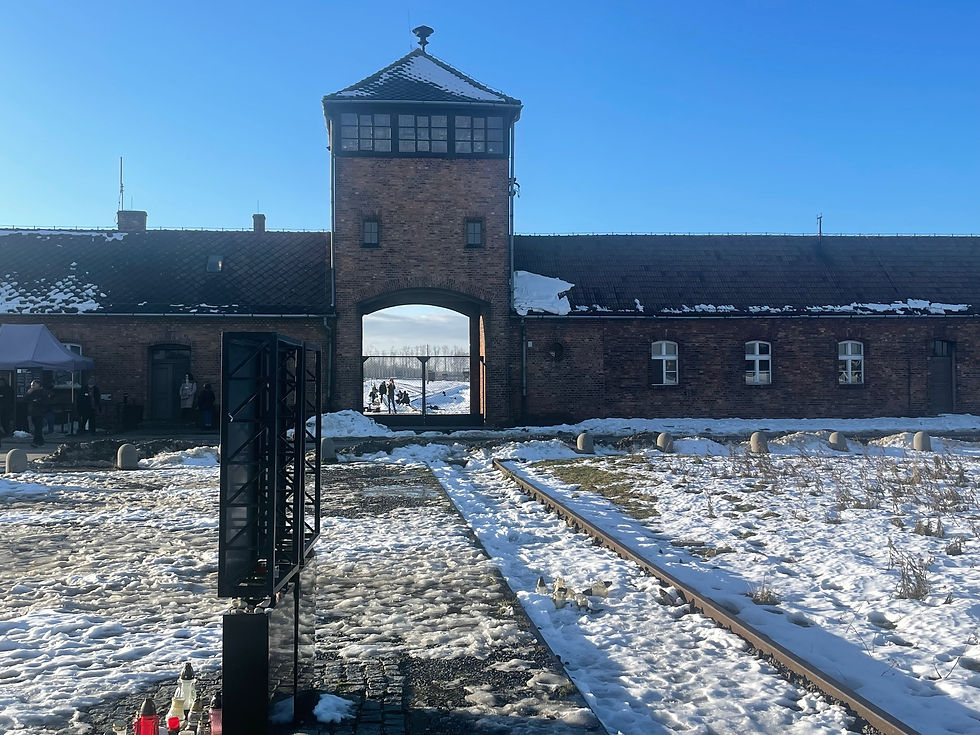
It's far colder and more exposed at Birkenau and difficult to see the whole scale of the enormous camp. While there are many of the original brick or wooden barracks buildings still standing, far more of them were destroyed by the Nazis during the last days of the camp's existence (between Oct 1944-Jan 1945). There are hundreds of chimneys in rows, all that remains of most of the buildings.
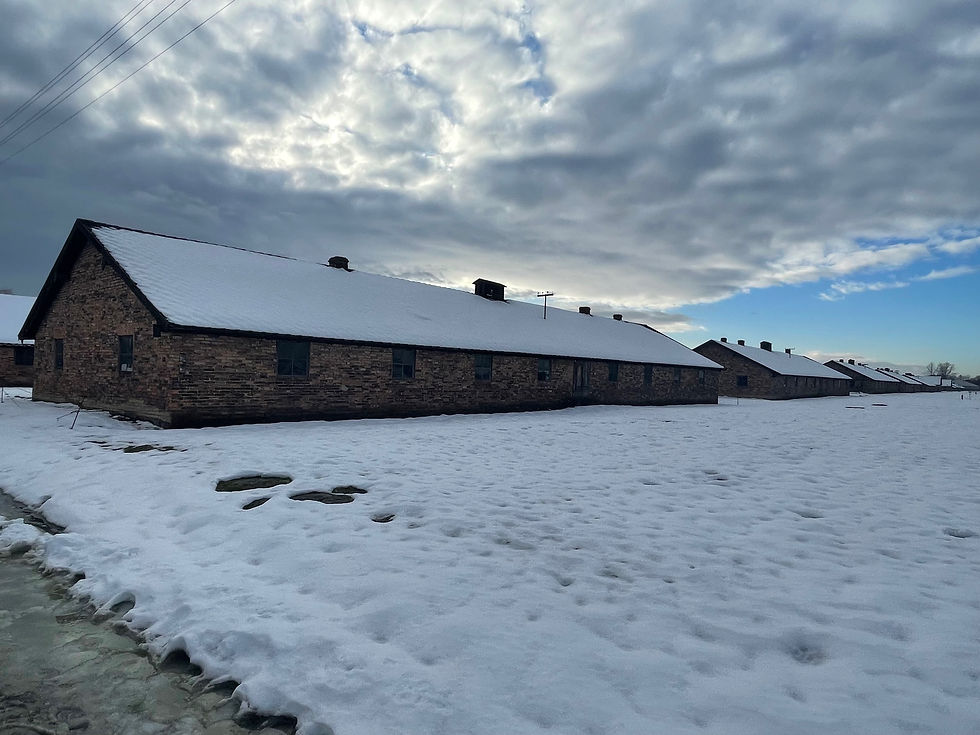

The four large gas chambers and crematorium buildings that were built to provide a total capacity of over 4,400 bodies a day were all blown up by the Nazis before they left the camp. The snow covered ruins make it hard to imagine the size and scale of the buildings but our guide provides plenty of details which manage to invoke the horror of what the people who experienced the camps must have gone through.


Before we leave the site we visit one of the barracks in the women's section of the camp, which remains as originally constructed except for the roof and the walkway around. Between 600-1000 women at a time were crammed into this unheated and poorly finished building, which was used for women who were ill and unable to work, and therefore selected for execution within hours or days. They were given no food or water as it was considered a waste. No women from this building survived the camp.

In total, over 1.1 million men, women and children lost their lives at Konzentrationslager Auschwitz-Birkenau.


Comments